Well, the results were surprising given all the news, rumors, and other opinions. This super bowl was expected to be close yet ended so lop-sided. The closest opinion was from someone saying that defense has won majority of the super bowl matchups.
My prediction of 37-27 (Denver) was crushed by the 43-8 (Seahawks).
Showing posts with label guesstimation. Show all posts
Showing posts with label guesstimation. Show all posts
Monday, February 3, 2014

Tuesday, January 28, 2014
Guesstimations: Super Bowl XLVIII - Predictions
Prediction: 37 - 27, Broncos
I watched only 1 game this season, NY Jets vs New Orleans Saints... so no help there. I just glanced at the average points scored and scored against. Here's a prediction from another site, Denver Broncos 1.5 points over Seattle Seahawks.
Reference
http://nfl.si.com/2014/01/20/super-bowl-xlviii-odds-denver-broncos-seattle-seahawks/
I watched only 1 game this season, NY Jets vs New Orleans Saints... so no help there. I just glanced at the average points scored and scored against. Here's a prediction from another site, Denver Broncos 1.5 points over Seattle Seahawks.
Reference
http://nfl.si.com/2014/01/20/super-bowl-xlviii-odds-denver-broncos-seattle-seahawks/
Sunday, March 31, 2013
Life: What is the cost per day to owning a car (Take 4 of infinite)
Purpose: There was a period of time that I lived in the city and did not own a car. I have always wondered what are the cost benefits of not owning a car. Besides the cost of the car, I also wanted to include gas and insurance.
Assumptions: Cost of the car is the total cost. This includes tax, fees, paperwork, registration, and basically anything to the one-time payment to purchasing a car. If you do not know how much those are, the cost of the car alone will probably be around $20-21k depending on where you live. The metrics that I have provided are from a 2012 Honda Civic which is about 10 months old. I did not include any other maintenance costs at this time but given a 10 year period, this cost should be negligible. I used 10 years because I figure almost all car models should be last at least 10 years. Calculating months, I assume month is approximately 30.42 days or (365 days / 12 months).
Estimate corrections: The car is newer so will be slightly more gas efficient than older cars. Gas efficiency is mix between regular mode and gas efficient mode. 80% of trips are within 15-30 miles; 20% 120 miles; about 2-4 trips over 500 miles.
Conclusion: The metro is approximately $2.50 / trip or $112 / month (45 trips to break even) or about $1350 / year, so commuting would save approximately $4000 / year. Living expense is much cheaper outside the city. On rent alone, I save approximately $800 / month or $9600 / year. Also, I expect my car to last more the 10 years (hopefully, 20 before any major problems occur) so effectively the final cost will be $6.58 less per day after 10 years. If you expect about $1000 in maintenance, then add approximately $2.80 per day.
Metrics:
Car: $24,000
Assumptions: Cost of the car is the total cost. This includes tax, fees, paperwork, registration, and basically anything to the one-time payment to purchasing a car. If you do not know how much those are, the cost of the car alone will probably be around $20-21k depending on where you live. The metrics that I have provided are from a 2012 Honda Civic which is about 10 months old. I did not include any other maintenance costs at this time but given a 10 year period, this cost should be negligible. I used 10 years because I figure almost all car models should be last at least 10 years. Calculating months, I assume month is approximately 30.42 days or (365 days / 12 months).
Estimate corrections: The car is newer so will be slightly more gas efficient than older cars. Gas efficiency is mix between regular mode and gas efficient mode. 80% of trips are within 15-30 miles; 20% 120 miles; about 2-4 trips over 500 miles.
Conclusion: The metro is approximately $2.50 / trip or $112 / month (45 trips to break even) or about $1350 / year, so commuting would save approximately $4000 / year. Living expense is much cheaper outside the city. On rent alone, I save approximately $800 / month or $9600 / year. Also, I expect my car to last more the 10 years (hopefully, 20 before any major problems occur) so effectively the final cost will be $6.58 less per day after 10 years. If you expect about $1000 in maintenance, then add approximately $2.80 per day.
Metrics:
Car: $24,000
Expected life: 10 years (~365 * 10)
Car per day: $6.575
Insurance (comprehensive): $1600 / year
Insurance per day: $4.38
Miles per day: 35 miles / day
Gas efficiency: 35 miles / gallon
Gas usage: 1 gallon / day
Cost of gas: $3.50 / gallon
Cost of gas per day: $3.50 / day
Total cost / day: $14.45 / day
Total cost / month: $439.52 / month
Total cost / month: $439.52 / month
Total cost / year: $5,274.25 / year
Costs do not include repairs, oil changes, and other maintenance costs.
Tuesday, February 5, 2013
Guesstimations: Super Bowl XLVII - Conclusions
The final score:
Both teams scored 10 points over my prediction, but my point spread holds. Even in hindsight, betting on a 3.5 - 4.5 points to either teams would have been extremely tricky.
The 108 yard return touchdown in the third quarter was unexpected. Due to the unexpected lack of offense from 49ers, this gave Ravens more time to score. This can explain for the extra 10 points.
The breakdown of the Ravens after the blackout which allowed 49ers 17 points in 5 minutes increased the expected output of the 49ers score. Plus, there was additional 2 points due to the Ravens voluntarily taking the safety to burn more time. This would explain the extra 9 points of the 49ers.
In conclusion, there were some sudden spurts of scoring that I did not account for even though the initial numbers were very arbitrary. This poses an interesting question if someone has a correctly guessed scores or spreads for a long history through pure "guesstimations" would have some scientific explanation.
Reference:
http://douglastclee.blogspot.com/2013/01/super-bowl-xlvii-predictions.html
http://www.nfl.com/gamecenter/2013020300/2012/POST22/ravens@49ers#menu=highlights&tab=recap
| Teams | Q1 | Q2 | Q3 | Q4 | F |
| Baltimore Ravens | 7 | 14 | 7 | 6 | 34 |
| San Francisco 49ers | 3 | 3 | 17 | 8 | 31 |
Both teams scored 10 points over my prediction, but my point spread holds. Even in hindsight, betting on a 3.5 - 4.5 points to either teams would have been extremely tricky.
The 108 yard return touchdown in the third quarter was unexpected. Due to the unexpected lack of offense from 49ers, this gave Ravens more time to score. This can explain for the extra 10 points.
The breakdown of the Ravens after the blackout which allowed 49ers 17 points in 5 minutes increased the expected output of the 49ers score. Plus, there was additional 2 points due to the Ravens voluntarily taking the safety to burn more time. This would explain the extra 9 points of the 49ers.
In conclusion, there were some sudden spurts of scoring that I did not account for even though the initial numbers were very arbitrary. This poses an interesting question if someone has a correctly guessed scores or spreads for a long history through pure "guesstimations" would have some scientific explanation.
Reference:
http://douglastclee.blogspot.com/2013/01/super-bowl-xlvii-predictions.html
http://www.nfl.com/gamecenter/2013020300/2012/POST22/ravens@49ers#menu=highlights&tab=recap
Friday, February 1, 2013
Guesstimations: Super Bowl XLVII - Predictions
I wonder how casinos creates the odds to sports games. This year for the Super Bowl, the most popular spread is the San Francisco 49ers 4.5 points over Baltimore Ravens. Points prediction seems pretty high with at least 5 touchdowns between both teams.
It would have been nice to collect some of the season data to create a more scientific prediction myself. But just from watching the last two games, my gut guess would be Ravens, 24-21.
Recommended:
http://douglastclee.blogspot.com/2013/02/guesstimations-super-bowl-xlvii.html
Recommended:
http://douglastclee.blogspot.com/2013/02/guesstimations-super-bowl-xlvii.html
Wednesday, January 30, 2013
Interview: How many quarters would you need to reach the height of the Empire State building?
How many quarters would you need to reach the height of the Empire State building?
Below are 4 different ways that I could answer the question. The third one is the standard answer you'll hear from most people. The others are just my way of being different... although they may have already been thought by other people but I didn't find any (not that I spent a lot of time trying).
1. Assuming you start at the base of the Empire State building and knowing that the tallest building is around half a mile in height, the cheapest way to reach the height of the building would be to hike up a mountain. I don't know where the closest mountain is, flights are rather cheap. All flights will reach the needed height, thus the cheapest flight will do. Flight can be as low as $79, so $100 would be a safe guarantee for a flight. Thus it would take 429 quarters, including $5 for the airtrain to JFK and subway ($2.25).
2. If you had to return back to the base, then a helicopter tour would be cheaper at $150. Thus 600, maybe 618 if you take the subway.
3. If assuming stacking quarters as most people would assume it is asking, then you'll need the height of the building and the thickness of quarters to determine the "minimum" number of quarters you will need. Empire is not the tallest so I'd take a wild guess that it is about a third of a mile, thus around 1500 feet. Thickness of a quarter is maybe a sixteenth of an inch. 4 quarters is about a quarter inch, so seems reasonable. Since we're estimating let's use 15 (because it seems like it would be a nice round number for 1500). 1500 feet = 18000 inches. 18k * 15 quarters / inch = 270,000 quarters.
4. Given that I cannot even stack quarters beyond a foot, you'll probably need a pyramid worth of quarters. Equation for a cone is (pi) * r ^ 2 *h / 3. 45 degrees is a safe angle to stack quarters without them shifting, so r will the same as h. (3.14159 * 18k ^ 3) / 3 ~ (20k ^ 3) = 8 * 10 ^ 12 in^3. Volume of a quarter is a (pi) r^2 * h. Quarter is about an inch wide, (3 * 1^2 * 1/16) = 3/16 ~ 1/4 in^3. So it would take apprximately 32 * 10^12 quarters to reach the height of the empire state building.
5. Add the cost of all the labor to complete #4.
One answer provided online is 263,000 quarters. My third number is not far from that value. I still think the fourth one is most reasonable, although I think the first and second are funnier.
Other notes: Elevator available to the public doesn't take you all the way to the top. There is an argument whether antennas should be included in the height of a build. Asking what/which quarter implies you can ask the height of the empire state building, thus that would not be a good question (but it may not hurt to ask).
Reference:
~ - approximately for easier calcuations
Question - http://www.techrepublic.com/blog/career/glassdoors-top-25-oddball-interview-questions-for-2013/4783
Anwer - http://answers.yahoo.com/question/index?qid=20070523180130AA8ll3C
http://en.wikipedia.org/wiki/Empire_State_Building
Height of Empire State Building (roof) = 1250 feet = 381.0 meters = 102 floors
Height of the tip of ESB = 1454 feet = 443.2 meters
Monday, January 28, 2013
Interview: Calculate the angle of analog clock
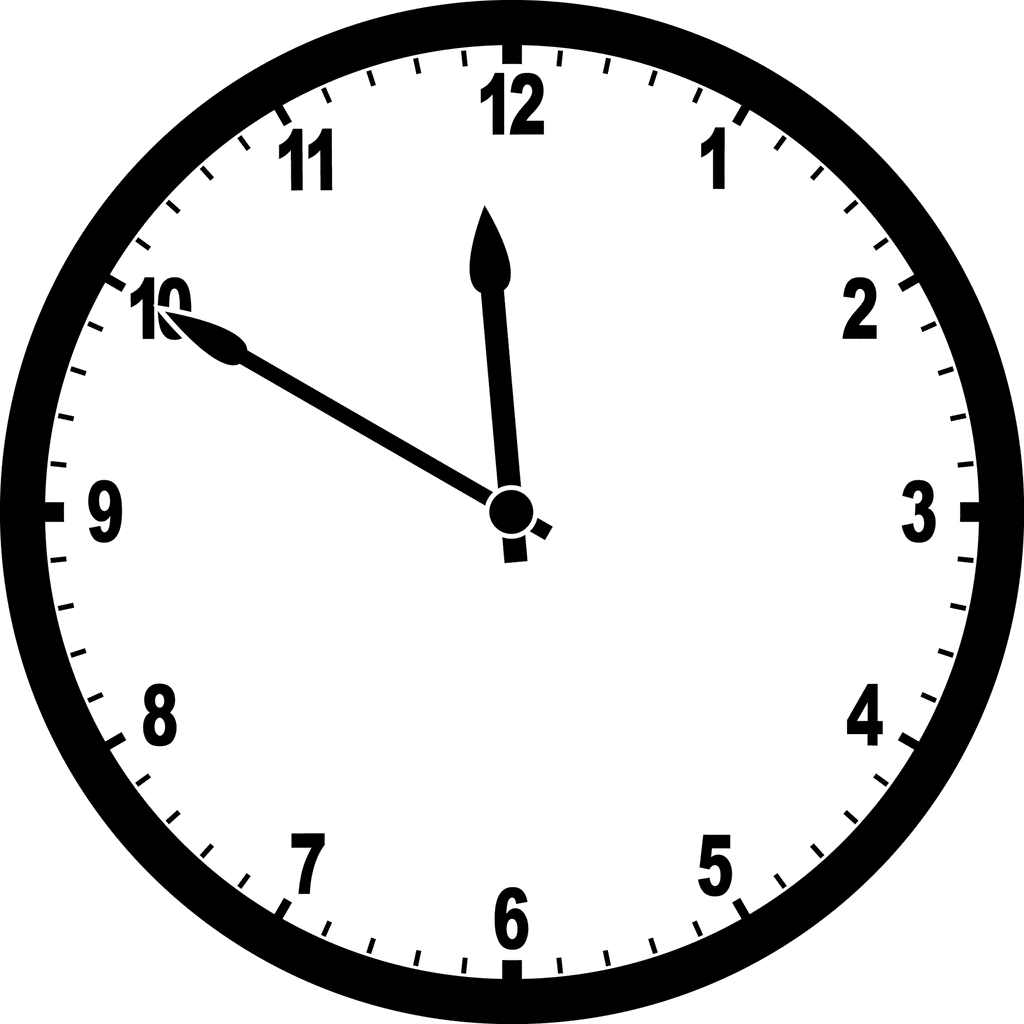
Calculate the angle of two clock pointers when time is 11:50
Continuing with some of the questions from Glassdoor's top 25 oddball questions... I am skipping around to whichever I find interesting. A couple of them are pretty common and already have rather standard answers. So, I picked this one because this turned out to have an extra step than what I originally thought.
Humor
Before I get to the common response, try one of the following if you're feeling lucky (disclaimer: make sure interviewer has the proper sense of humor)... the angle is the difference between meeting a deadline and getting fired... 0 degrees because it takes you 10 minutes to solve it... 90 or 180 on a digital clock... null, pointers have no direction in [programming language].
My Thought Process
At first glance, I thought the answer was 60 degrees because 11:50 is 10 minutes before noon/midnight. 10 minutes of 60 minutes in an hour = 1/6. Clock is 360 degrees, so 60 degrees. Then made a sanity check by trying to picture the clock at 11:50.
I quickly realized that the hour hand would not exactly be at the o'clock position. The hour hand would be slightly before the 0 degree (assuming o'clock is my reference). Each hour move 30 degrees (because each hour is the distance as 5 minutes which is half of 10 minutes). Thus for each minute, the hour hand would move 1/60 of 30 degrees, 0.5 degree.
The answer would be 60 degrees - 0.5 degrees * 10 minutes. Final answer is 55 degrees.
Additional Follow Up
A good potential follow up to this may be to provide the general equation (ie function, method, etc.) to generate the value for any time. Given X minutes and Y hours with noon as the 0 degree reference, the minutes degree will be X / 60 * 360 = X * 6 and hours degree will be X / 2 + 30 * Y. Thus, the final equation is |X * 6 - (X / 2 + 30 * Y)|. Test with original points, |50 * 6 - (50 / 2 + 30 * 11)| = |300 - (25 + 330)| = |-55| = 55. Test with 12:10, |10*6 - (10 / 2 + 30 * 0)| = |60 - (5 + 0)| = 55. Simplify the equation, | X * 5.5 + Y * 30|.
Add constraints... 0 <= Y < 24 and 0 <= X < 60. Y must be an integer; X must be a real number. If Y >= 12, then Y = Y - 12.
Some extra thoughts... If a graphic artist, then provide a time entry GUI. If animator, provide equation for reference to 3D space (ie angle if clock is angled at certain positions). If math, provide equation if only provided the positions of the two lines. If high school degree, use approximation because you should know that 3 and 9 are right angles so 90 degrees, so 10 (i.e. 50 minutes) and 11 breaks the 90 degrees into thirds, thus each hour is 30 degrees which gives you 60 degrees minus a few degrees. If physics, then ask about the velocity the clock is traveling at.
30 Degrees?
Guesstimation
Assuming you have figured there are 30 degrees between each hour, you can see that the answer must be greater than 30 degrees. From looking at the image above, you can see that the answer should be closer to 60 degrees. You will also notice that the hour hand is not exactly at the 12 mark. Therefore, the answer is less than 60 degrees. Mathematically, you should be able to estimate that the answer is between 30 and 60 degrees. If you eye ball the difference, you should be around 50-55 because 45 degrees would be symmetrically in the middle.
Misconception
I found that 30 degrees was a common answer to this question. This primarily comes because the image is of the hour hand on the 11 mark and the minute hand on the 10 mark. What is not considered is that the hour hand moved past the 11 mark due to the minute hand moving to the 10 mark.
Fortunately for me, my thought process was going from noon and going back 10 minutes. So I naturally picked up that the position of the hour hand was impacted by the minute hand. This is why I typically do a sanity check particularly with questions that appear simple but you get an uneasy feeling there is something amiss. For example, why would they be asking a simple geometric question in an interview? Or in this example, why would this be a top 25 list of oddball questions if the answer is so direct?
Reference
http://www.techrepublic.com/blog/career/glassdoors-top-25-oddball-interview-questions-for-2013/4783Updated 1/24/2014 - Added section for 30 degrees to explain how the answer is not 30 degrees.
Friday, January 18, 2013
Interview: How many cows are in Canada?
How many cows are in Canada?
I was surfing around stumbled on this interview question. At first, this appeared to be one of those break down the problem to smaller more manageable parts, like "How many quarters would you need to reach the height of the Empire State building," or "Estimate how many windows are in New York." But then I quickly realized, I do not have the faintest idea what the base case should be. Below is my thought process to answer the question with my current knowledge without looking up facts.I think the premise of the question is really how I troubleshoot or go about the question more than the correct answer like the questions mentioned above. There are many factors that cannot be used because I do not know the start or end points of such data, like how much milk is produced or how much beef is consumed. I do not know how much is consumed domestically nor how much is exported for the former data point. I do not know how many people eat beef nor even the frequency.
To start, I think my solution would be some sort of range that I slowly refine as much as I can with smaller error. This will cause a wider range, but at least it is some information that can be used. Assuming there are cows that are kept for recreational purposes, I will assume this number is negligent. With that assumption, cows are raised for the purpose of consumption or to produce goods for consumption (ie milk).
Starting with calculating the upper range and consumption, I will assume cows (around 500 - 1000 pounds) weight about 750 pounds [from memory]. A person who normally eats beef will eat about 1 pound per week. Because most hamburgers and steaks are served in units of quarter pounds to one pound, and on rare occassion 32 ozs. Anything larger is assumed negligent [round up for upper range, down for lower range if necessary]. 1 pound seems like a lot of beef. So for 50 weeks (slightly less than a year but makes it easier to calculate), a person will eat about 50 pounds per year. So a cow will feed at most 15 people.
I do not know the population of Canada, but the US is about 300M (I actually know this number). Canada is about the same size but a good amount of the land area is not populated. I'd guesstimate that is is about a third of the US, so the population is 100M (also a nice round number). 100M / 15 = 6.67M, so approximately 6.67M cows are needed for consumption assuming all people eat approximately 1 pound / week. Another assumption is that Canadians eat as much or less than Americans.
At this point, I will realize I am taking too much time, so I'll guess that it is about 5 years. My answer would be between 7M and 35M cows. With some sanity check that it is less than a billion cows and more than hundreds of cows.
As good practice, I would email research afterwards to show that I am also capable of following up and doing research. Provide online resources if you need to demonstrate that you can web search.
After minimum research, there are approximately 13M cows in Canada. Canada has a population of 35M. Approximately 91M cows in US. US has a population of 311M. US consumes 26B pounds of beef. 0.012 pounds of beef per person per year. Although the final number fell into the range I provided, using the calculations above, I should have come between 2.3M and 11.5M. A cow's life is between 1-2 years for meat and 15 years for dairy. An easier way to remember is that there are about a third of the country's population. I'd estimate less for other countries unless they export cows, but that's enough research for a blog.
Prologue
Also see post on other methods I would answer the questionAfter doing a few more practices of other forms of this question, I've found that I do have some idea approximately what the number should be. There may be some tendency to fidget which metrics to use to estimate the final number because my final numbers tend to be within a range that surprises even myself. So just remember, typically these questions is just your process of thinking. You may come up with the worst guess but may have the best explanation, and it is the latter that has greater weight and for some interviews may be the only weight.
Update
7/31/2014 - Checking on some old subjects and stumbled across a new link on how this question is not useful. I agree that there are more effective questions (as I've noted in My Take on Odd Questions). It does have its use but has too many variables to consider. Either way, a candidate should still be prepared for these questions because there will be some companies that will ask this type of questions. For me, I still enjoy thinking of different variants. It kind of has a nice intention to test one's imagination.
Reference
http://publications.gc.ca/site/archivee-archived.html?url=http://publications.gc.ca/collections/collection_2011/statcan/23-012-X/23-012-x2010002-eng.pdfhttp://www.greenkeyllc.com/blog/2013/06/google-no-longer-cares-how-many-cows-there-are-in-canada/
Subscribe to:
Posts (Atom)